I have been watching more political coverage than I usually do, even for a presidential race. Part of it is the unprecedented hijacking of the process by an egotistical blow hard whose response to probing questions is usually a dodge followed by a personal insult. Like a moth to the flame, I can't seem to stop watching. Normally politics bore me or disgust me. In an effort to draw contrasts, candidates demonize their opponents and are very loose or misleading with their "facts." Small differences between candidates balloon into earth-shattering crises. And, of course, every problem in the world is the fault of the party in power according to the current party out of power. In an effort to provide a bit of perspective I want to comment on a few things I have noticed that seem particularly note worthy and some of the things that bug me the most.
By way of self disclosure, so my biases are know upfront, I tend to lean left on social issues and my world view is much more secular than religious. However, I would not say that I perfectly align with the complete platform of either major party. I reserve the right to form my opinions on an issue-by-issue basis regardless of party alignment, and for many issues I don't think I know or care enough to have a particularly strong opinion at all.
So with those qualifications and disclosures, here are some of my observations, likely worth exactly what you paid for them. In watching the coverage of the Iowa caucuses and the coverage leading up to them, I noticed some striking contrasts between the parties. I learned from the Republicans that President Obama is the devil incarnate and that absolute every problem in the world is his fault. He is the worst president we have ever had. The terrible trends of the last 8 years can be reversed if we can just get a Republican in the White House this time.
I wonder if these people are living in the same world I am. Did we not have the worst economic down-turn since the Great Depression just before Obama took office? Have we not since had the longest period of sustained growth since the end of World War II? Wasn't Obama instrumental in passing the most significant health-care legislation in our history that has helped millions of Americans get health coverage who did not have it previously? Other accomplishments include opening diplomatic relations with Cuba, the Iran nuclear deal, and, of course, taking out Bin Laden. This is despite being blocked by congress at nearly every turn. America's international prestige took a hit during the administration of George W. Bush, but under Obama we are now far more respected in the international community. Perhaps there is disagreement on whether the Iran deal was a good thing, but I believe that future generations will count Obama as one of the better presidents. You would never know this by listening to the Republicans.
Early in the campaign there was talk about how unsafe we are in the wake of the San Bernardino shootings. This was put into perspective on an episode of GPS with Fareed Zakaria's. Zakaria pointed out that since the terrorist attack on 9/11/2001 there has been an average of 4 American deaths each year due to terrorism. In contrast, there are over 11,000 deaths each year due to gun violence not involving terrorists. There are an average of 51 deaths in the US each year due to lighting strikes. Americans are far more likely to be struck by lightning than to die in a terrorist attack. To be consistent, we should be clamoring for the government to protect us from lightning strikes. The truth is that terrorism is all about perception and fear, not a real probability of a threat. In this sense the fear mongering is actually aiding the terrorists by creating a greater sense a panic than what is warranted from the actual probabilities.
I have heard many Republican candidates talk about the US being in a crisis. What are they talking about? A crisis compared to what? There is no historical perspective in this rhetoric. I don't want to be dismissive of anyone who has experienced hardship due to loss of a job and stagnant wages, but think about how this compares to some of the historical crises previous generations have faced such as the civil war, two world wars, the great depression, and the anxiety of the cold war era. The reality is that we are close to full employment, crime is down, people are living longer, and it has been decades since we have been involved in a war against an equally powerful enemy. The average American lives better than royalty lived as recently as 200 years ago. I think "Better Angels of our Nature" by Steven Pinker should be required reading. Of course, because of how the brain works, our problems seem just as big to us as problems in the past seemed to our ancestors. We get used to the status quo. Still, some of the political rhetoric seems way over the top.
Many Republicans want to return to a time when things were better, before the liberals destroyed the country with their attacks on the family and attacks on religious liberty. I heard these sentiments expressed by many Evangelical Christian Iowa voters interviewed by CNN who asserted that they were in favor of traditional values such as the marriage of a man and a woman and religious liberty. I found my self yelling at the TV, "Who is stopping you from holding those values and practicing your religion?" Since when, I have wondered, did the definition of liberty change from doing what you want to forcing others to do what you think they should? I don't think these people understand what liberty means. They have also said that they want to vote for someone of high moral and ethical character. In other words, someone who is a Christian like them. I don't think religion is necessarily correlated with morals and ethics. I have known many atheists and agnostics who are very ethical and moral, and some Christians who are not.
It is interesting to me that many of the Republican goals, especially that of the Christian right, seem to be about codifying Christian beliefs into law and forcing everyone else to live by them, even when failure for others to conform to Christian-specific beliefs hurts no one so long as people are otherwise law abiding. In contrast, the Democratic candidates have emphasized adopting policies that benefit everyone such as universal health care, college tuition assistance, and equal and fair treatment for all regardless of race, religion, gender, and sexual orientation. I find it ironic that Republicans are all about smaller government and preserving individual freedom when it comes to corporate regulations, freedom of religion, and gun rights, but they seem to be about more government intervention when it comes to forcing their own version of morality on others. Somehow this seems philosophically inconsistent to me. Either you want to preserve individual freedoms for everyone (when they don't interfere with the rights of others) or you don't. It is hypocritical to insist on the freedoms important to you while denying the same rights to others.
Perhaps my views are biased, but I think even a neutral observer would have to notice the dramatic contrast. The level of discourse has been much more mature and substantive in the Democratic debates where issues are discussed in a respectful tone. In contrast, the Republican debates often degenerate into a contest of personal insults. Of course, most of this tone is due to a single candidate, Donald Trump. The discourse was much improved in the debate he boycotted when the vitriol was mostly limited to the absent candidate and the Democrats. All this has led to greater entertainment value in the Republican debates, which is partly why I can't stop watching. I am just not sure if ratings-based reality TV is the best way to choose who gets to hold the most powerful office in the world.
Thursday, February 4, 2016

Wednesday, January 27, 2016
Do You Believe in God?
My dad, who died last year just before his 92nd birthday, never expressed much confidence in an afterlife. As a kid, I remember him saying that when you are dead you are just dead. You no longer exist. I don't know if my dad changed his mind about this later, but at his funeral my brother-in-law expressed his opinion that this may have been the case. My brother-in-law is an active, believing Mormon and a former bishop, while I am more of a skeptical agnostic. As evidence for my dad's transformation my brother-in-law cited examples of my dad offering touching prayers in front of family members. What he did not know is that my dad had always done that on very special occasions, interspersed with the times I heard him express deep skepticism.
This raises a number of questions for me. Why was it so important for my brother-in-law to believe that my dad believed in God? Who is this God anyway, and why does he require belief? It seems to be an almost universal assumption that belief in God is a good thing and that it is something that God requires or even demands of us. Why is this the case? When I think about all the implications of this it starts to fall apart and seems to be more a characteristic of the human psyche or human culture than a characteristic of an actual deity.
The more I think about this issue the more I come to the conclusion that any God worthy of respect and adoration probably does not care whether anyone actually believes in him or her. Furthermore, some of the assumptions about God inherited through the Judeo-Christian, monotheistic tradition are so deeply ingrained that it rarely occurs to us to question them. Questioning many of these assumptions and pointing out that they are not necessarily logically connected is what I propose to do in this post.
Assumption 1: Faith is a virtue
This raises a number of questions for me. Why was it so important for my brother-in-law to believe that my dad believed in God? Who is this God anyway, and why does he require belief? It seems to be an almost universal assumption that belief in God is a good thing and that it is something that God requires or even demands of us. Why is this the case? When I think about all the implications of this it starts to fall apart and seems to be more a characteristic of the human psyche or human culture than a characteristic of an actual deity.
The more I think about this issue the more I come to the conclusion that any God worthy of respect and adoration probably does not care whether anyone actually believes in him or her. Furthermore, some of the assumptions about God inherited through the Judeo-Christian, monotheistic tradition are so deeply ingrained that it rarely occurs to us to question them. Questioning many of these assumptions and pointing out that they are not necessarily logically connected is what I propose to do in this post.
Assumption 1: Faith is a virtue
Faith is not universally acknowledged as a virtue. For example, atheists value skepticism, evidence, and reasoning above faith. What I am asking here is why religious people universal acknowledge faith as one of the highest virtues. Why do they assume that a God would require faith? If I accept that a God exists (which I am not at all sure about but will concede for argument's sake), I might try to imagine the mind of God using an analogy. Perhaps we are to God as a colony of ants is to me. I can't imagine caring in the slightest whether a colony of ants believes in me. I don't need them to believe in me. It does absolutely nothing for me one way or another. I am perfectly fine with them going about their little ant lives as ants do. I do not begrudge them pursuing their goals of surviving and thriving as long as they stay out of my kitchen.
When I think about what is actually accomplished by faith, the main answer that I can come up with is that it makes things more convenient for people in positions of authority. It prevents subjects or followers from asking hard questions and challenging the authority of those in power over them. An all-powerful God would not need it, but humans in authority very much need it since the masses so greatly outnumber them. If those in power can placate their subjects by getting them to accept things on faith, their hold on power is more secure. Of course, we may also be psychologically wired for this, and it was probably more important historically than today. The main point is that emphasis on faith seems to serve human wants and needs rather than divine ones.
I can't imagine why an all-powerful God would insist on faith, especially if he cares at all about our growth and development. I want my own children to learn to be self sufficient and independent. I want them to think critically, question authority, and learn to solve problems on their own. Why would a loving God want anything different? Insisting on faith seems a bit insecure. Maybe some parents insist on unquestioning obedience from their children, but I don't consider such parents to be particularly enlightened, and I expect God to be more enlightened that the most enlightened humans.
So who am I to tell God how she should behave? That is a good question, but since none of us has direct access to God we are left to create God in our own image. So while I may be guilty of creating a God in my own image, or at least in an image that I aspire to, aren't those who insist on faith doing pretty much the same thing? I don't believe any of us have privileged access so it is the best we can do. Whether we imagine a vindictive and vengeful God or a kind and loving God probably says more about us than it does about God. Insisting that everyone believes in the God we imagine probably speaks more to our own insecurities than to any actual attributes of a deity.
Assumption 2: Belief in God and belief in the afterlife are basically the same thing
When I think about what is actually accomplished by faith, the main answer that I can come up with is that it makes things more convenient for people in positions of authority. It prevents subjects or followers from asking hard questions and challenging the authority of those in power over them. An all-powerful God would not need it, but humans in authority very much need it since the masses so greatly outnumber them. If those in power can placate their subjects by getting them to accept things on faith, their hold on power is more secure. Of course, we may also be psychologically wired for this, and it was probably more important historically than today. The main point is that emphasis on faith seems to serve human wants and needs rather than divine ones.
I can't imagine why an all-powerful God would insist on faith, especially if he cares at all about our growth and development. I want my own children to learn to be self sufficient and independent. I want them to think critically, question authority, and learn to solve problems on their own. Why would a loving God want anything different? Insisting on faith seems a bit insecure. Maybe some parents insist on unquestioning obedience from their children, but I don't consider such parents to be particularly enlightened, and I expect God to be more enlightened that the most enlightened humans.
So who am I to tell God how she should behave? That is a good question, but since none of us has direct access to God we are left to create God in our own image. So while I may be guilty of creating a God in my own image, or at least in an image that I aspire to, aren't those who insist on faith doing pretty much the same thing? I don't believe any of us have privileged access so it is the best we can do. Whether we imagine a vindictive and vengeful God or a kind and loving God probably says more about us than it does about God. Insisting that everyone believes in the God we imagine probably speaks more to our own insecurities than to any actual attributes of a deity.
Assumption 2: Belief in God and belief in the afterlife are basically the same thing
I have sometimes heard believers reveling in what will happen to atheists when they die. They will finally know that they were wrong when they discover that they can still see, think, and feel even though they are no longer occupying their physical body. But what have they really discovered? I am not insisting that this is what actually happens, but suppose that it does. The only thing they have learned, assuming that they are not hallucinating, is that there is a part of them that lives independent of their body. They have not learned anything about the existence of God. Conversely, the existence of God does not necessarily imply the existence of an afterlife. Many religious traditions assume the existence of God or Gods, but say nothing about an afterlife for individual humans. The Bible itself, especially the Hebrew Bible (Christian Old Testament), says very little about the afterlife. Even Christian traditions that allow for an afterlife for humans may deny its existence for other forms of life. So the existence of God does not guarantee an afterlife for our dogs, for example, according to many traditions. Questions about God and the afterlife are independent.
Assumption 3: God is Omnipotent and Omniscient
There seems to be an unspoken assumption among the monotheistic traditions that certain attributes are implicit in the definition of God, among which are omnipotence (all-powerful), omniscience (all-knowing) and omni-present (everywhere at once). Most monotheists also assume that God's existence extends into the infinite past and the infinite future. This is only one possible way to view God. Many other possibilities exist. The God of the Deists got the universe started, but does not intervene in day-to-day affairs. The Gods of ancient Greece and Rome as well as many Hindu Gods are limited in power and knowledge, while still being immortal and much more powerful than humans. God could be defined merely as the most intelligent of all intelligent beings in the Universe. By this definition, God could be an advanced alien.
The assumed divine attributes of omnipotence and omniscience are not well defined and they may be logically inconsistent or impossible. One version of this dilemma is "Can God create a rock so big that he cannot lift it?" or Homer Simpson's version, "Can God create a burrito so hot that he cannot eat it?" While these are humorous ways to illustrate this dilemma, they nevertheless make a valid point. These attributes may very well be the theological equivalent of dividing by zero in mathematics. In other words, the God of the monotheistic religions is undefined. While this may be considered a virtue in traditions that emphasize mystery, the question remains as to whether the rules of logic apply to God so that only a logically consistent God is possible. Perhaps this could be resolved by tightening up the definition of omnipotence to mean all possible power rather than all arbitrarily conceivable power.
In the design of computer chips it is possible to create a logically inconsistent circuit by feeding the output back into the input and creating the electronic equivalent of the propositions "everything I say is a lie" and "I am lying now." You end up with a rapidly oscillating circuit that is not good for doing any useful work. Chip designers are well aware of this and avoid ever designing it into their chips. It seems to me that a God would also need to avoid such logical errors or he could make his own or the universe's existence unstable or impossible. Part of his omniscience should include knowing how to avoid such errors, not the arbitrary power to make them without consequence.
Belief in God
There seems to be an unspoken assumption among the monotheistic traditions that certain attributes are implicit in the definition of God, among which are omnipotence (all-powerful), omniscience (all-knowing) and omni-present (everywhere at once). Most monotheists also assume that God's existence extends into the infinite past and the infinite future. This is only one possible way to view God. Many other possibilities exist. The God of the Deists got the universe started, but does not intervene in day-to-day affairs. The Gods of ancient Greece and Rome as well as many Hindu Gods are limited in power and knowledge, while still being immortal and much more powerful than humans. God could be defined merely as the most intelligent of all intelligent beings in the Universe. By this definition, God could be an advanced alien.
The assumed divine attributes of omnipotence and omniscience are not well defined and they may be logically inconsistent or impossible. One version of this dilemma is "Can God create a rock so big that he cannot lift it?" or Homer Simpson's version, "Can God create a burrito so hot that he cannot eat it?" While these are humorous ways to illustrate this dilemma, they nevertheless make a valid point. These attributes may very well be the theological equivalent of dividing by zero in mathematics. In other words, the God of the monotheistic religions is undefined. While this may be considered a virtue in traditions that emphasize mystery, the question remains as to whether the rules of logic apply to God so that only a logically consistent God is possible. Perhaps this could be resolved by tightening up the definition of omnipotence to mean all possible power rather than all arbitrarily conceivable power.
In the design of computer chips it is possible to create a logically inconsistent circuit by feeding the output back into the input and creating the electronic equivalent of the propositions "everything I say is a lie" and "I am lying now." You end up with a rapidly oscillating circuit that is not good for doing any useful work. Chip designers are well aware of this and avoid ever designing it into their chips. It seems to me that a God would also need to avoid such logical errors or he could make his own or the universe's existence unstable or impossible. Part of his omniscience should include knowing how to avoid such errors, not the arbitrary power to make them without consequence.
Belief in God
The question in the title of this post, then, might not be so simple given the problematic nature of some widely-held assumptions about the attributes of God. My answer is that it depends on what you mean by God. This makes all the difference. My answer is "no" for nearly every God I have heard described, but that does not mean "no" for any conceivable God. Perhaps all the various beliefs in God are like the blind men feeling the elephant in the oft-repeated proverb. Some describe it as a tree, some as a snake, and some as a rope. So maybe each tradition has a portion of the truth by giving a view from one particular angle without comprehending the whole. It may also be that none of them are anywhere close and the nature of God has yet to be conceived by the mind of humans.
I subscribe to the idea that views about God reflect the attributes of the believer more than the attributes of God. This is what initially attracted me to my wife. Her view of God emphasized kindness and compassion, which are attributes that she has. I have also noticed that those who believe in a vengeful God tend to exhibit that trait themselves. This may not always be the case because many people believe in the God they first learned about as children and never question his attributes. Over time, however, whether they move closer to their God or their God moves closer to them, people seem to grow to resemble their Gods.
One of the attributes of the God I was raised to believe in is that he is a bureaucratic paper pusher. He is a being that would keep someone out of super VIP heaven (as Brother Jake calls it) for not having his proper papers in order. It makes no sense to me that God would be so anal. The longer I live the more a subscribe to a universalist view of God. It makes no sense to impose an infinite penalty for a finite infraction. I cannot and will never believe in the Christian view of hell. My aversion to this is aided by the fact that I was not really brought up with this view of hell. However, I don't subscribe to the Mormon view of the afterlife either where you are forever assigned to a particular kingdom. I am open to the possibility of something like Catholic purgatory where individuals have to work some things out, but ultimately they come through this temporary state. It is the eternal hell that I refuse to believe in.
Ultimately my dad may have been right. Maybe there is nothing. On the other hand, if there is a God and an afterlife I don't think it will make any difference whether my dad believed it or not. If God sent my dad to hell for not believing, he is not a being I would worship or would care to be with. How could anyone enjoy heaven knowing some of their loved ones, friends, or even casual acquaintances were suffering in hell for eternity? People who are OK with this are not the type of people I would care to associate with for eternity. So it makes no difference to me at all whether or not my dad believed. I only know that he loved his family and that he was the most generous, loving, and humble man I have known. I think that is quite enough. I would rather be wherever he is than with many self-described believers that I know.
I subscribe to the idea that views about God reflect the attributes of the believer more than the attributes of God. This is what initially attracted me to my wife. Her view of God emphasized kindness and compassion, which are attributes that she has. I have also noticed that those who believe in a vengeful God tend to exhibit that trait themselves. This may not always be the case because many people believe in the God they first learned about as children and never question his attributes. Over time, however, whether they move closer to their God or their God moves closer to them, people seem to grow to resemble their Gods.
One of the attributes of the God I was raised to believe in is that he is a bureaucratic paper pusher. He is a being that would keep someone out of super VIP heaven (as Brother Jake calls it) for not having his proper papers in order. It makes no sense to me that God would be so anal. The longer I live the more a subscribe to a universalist view of God. It makes no sense to impose an infinite penalty for a finite infraction. I cannot and will never believe in the Christian view of hell. My aversion to this is aided by the fact that I was not really brought up with this view of hell. However, I don't subscribe to the Mormon view of the afterlife either where you are forever assigned to a particular kingdom. I am open to the possibility of something like Catholic purgatory where individuals have to work some things out, but ultimately they come through this temporary state. It is the eternal hell that I refuse to believe in.
Ultimately my dad may have been right. Maybe there is nothing. On the other hand, if there is a God and an afterlife I don't think it will make any difference whether my dad believed it or not. If God sent my dad to hell for not believing, he is not a being I would worship or would care to be with. How could anyone enjoy heaven knowing some of their loved ones, friends, or even casual acquaintances were suffering in hell for eternity? People who are OK with this are not the type of people I would care to associate with for eternity. So it makes no difference to me at all whether or not my dad believed. I only know that he loved his family and that he was the most generous, loving, and humble man I have known. I think that is quite enough. I would rather be wherever he is than with many self-described believers that I know.
Friday, September 18, 2015
Religious Truth
My previous post might seem a bit anti-religion. It was not intended to be. I consider myself a science advocate because I believe science has brought more benefit to mankind than any other cognitive construct, and that it is the most effective tool ever devised for revealing the secrets of the natural world. However, I am not anti-religion. I like some religions more than others, but I do not completely accept the idea that "religion poisons everything" as expressed in the subtitle of Christopher Hitchens' book, "God is Not Great." I am not completely on board with the new atheists such as Richard Dawkins, Christopher Hitchens, and Sam Harris. I believe that religion provides a net benefit to society and that the criticism of the new atheists results from cherry picking the worst examples of religions influence.
I believe that religion reveals a type of truth, just not the truths that literalistic believers think it does. It does not reveal the truth about worlds beyond this one or the secrets of setting yourself up well for the next life. Nobody knows the answers to those questions despite their strong convictions to the contrary. We can demonstrate conclusively that religion has an atrocious track record of accuracy in trying to reveal truths about the natural world that are accessible to science. Rather, its value lies in its insight into the human mind, motivation, social cohesion, mental health, and its ability to organize and motivate giving to private charity. Secular organizations, despite their good intentions, never seem to be able to do this quite as well.
I once tried to explain to a very literalistic believer in my former faith the things I valued about the religion I grew up with, which included the items mentioned above. His response was that if the claims of the religion were not literally true, then the religion was basically worthless. If the unique beliefs about the afterlife were not true, then participation is pointless. It seems that on this point he would be in agreement with the new atheists if he were to ever discover that his beliefs were not literally true. However, there is a middle ground that is more than a mere compromise.
I believe that the best religion has to offer fulfills a deep need in the human psyche that nothing else satisfies as well. This is not dependent on the literal truth of the religious belief, but it is dependent on how humans are put together. The proclivity to insist on literal truth in spiritual texts is a modern tendency that was not shared by the ancients. Religious literalism is doomed to fail eventually once the populace becomes sufficiently informed and open minded enough to reject religious claims contradicted by solid science. Unless literal believers can transition over to a symbolic, less-literal interpretation of their foundational texts they will likely miss out on the benefits that go beyond a literal, historical interpretation.
So why is religion so effective at what it does? Religion has been around long enough to have accumulated deep wisdom into profound human psychological and social needs. At least this is true of the old religions. Some of the newer religions have not yet acquired this wisdom, but rather, they exploit the deep psychological needs of its followers in order to placate the ego of a charismatic leader. I believe that some of these newer religions can be more harmful than beneficial. They still may fulfill some of the same needs, but at way too high of a cost in terms of time, money, and intellectual integrity.
Another question that occurs to me is, do we need to believe literally in order to reap the benefits religion has to offer? Put another way, can we behave ourselves without the literal belief that the Great Sky Daddy will punish us if we don't? Once children discover that Santa Clause is not real, we can no longer use that to motivate and control them. Once we see the man behind the curtain, the great Oz loses his power to awe and intimidate. However, I believe the greatest benefits of religion go beyond this simplistic method of social control. I still feel a great sense of awe and comfort participating in religious rituals, despite my non-literal beliefs.
I feel especially attracted to religions that acknowledge mystery rather than believing in the illusion that they have everything figured out. I also appreciate a religion that can accept me as I am, despite my skepticism. I do not understand why faith is considered such a high virtue when the ability to think and reason can often serve us much better. Finally, I will never again participate in a religion where I have to check my brain at the door or pretend to be something I am not. My former religion treated me as if I was the one with the problem, while the problem all along was that they were absolutely certain of things that are just not so. I have a quite different view than I once did of the words attributed to Jesus, "the truth shall set you free." The truth has set me free of limiting fundamentalist, literalistic beliefs and taken me to a place where I have found peace, comfort, love, and acceptance.
I believe that religion reveals a type of truth, just not the truths that literalistic believers think it does. It does not reveal the truth about worlds beyond this one or the secrets of setting yourself up well for the next life. Nobody knows the answers to those questions despite their strong convictions to the contrary. We can demonstrate conclusively that religion has an atrocious track record of accuracy in trying to reveal truths about the natural world that are accessible to science. Rather, its value lies in its insight into the human mind, motivation, social cohesion, mental health, and its ability to organize and motivate giving to private charity. Secular organizations, despite their good intentions, never seem to be able to do this quite as well.
I once tried to explain to a very literalistic believer in my former faith the things I valued about the religion I grew up with, which included the items mentioned above. His response was that if the claims of the religion were not literally true, then the religion was basically worthless. If the unique beliefs about the afterlife were not true, then participation is pointless. It seems that on this point he would be in agreement with the new atheists if he were to ever discover that his beliefs were not literally true. However, there is a middle ground that is more than a mere compromise.
I believe that the best religion has to offer fulfills a deep need in the human psyche that nothing else satisfies as well. This is not dependent on the literal truth of the religious belief, but it is dependent on how humans are put together. The proclivity to insist on literal truth in spiritual texts is a modern tendency that was not shared by the ancients. Religious literalism is doomed to fail eventually once the populace becomes sufficiently informed and open minded enough to reject religious claims contradicted by solid science. Unless literal believers can transition over to a symbolic, less-literal interpretation of their foundational texts they will likely miss out on the benefits that go beyond a literal, historical interpretation.
So why is religion so effective at what it does? Religion has been around long enough to have accumulated deep wisdom into profound human psychological and social needs. At least this is true of the old religions. Some of the newer religions have not yet acquired this wisdom, but rather, they exploit the deep psychological needs of its followers in order to placate the ego of a charismatic leader. I believe that some of these newer religions can be more harmful than beneficial. They still may fulfill some of the same needs, but at way too high of a cost in terms of time, money, and intellectual integrity.
Another question that occurs to me is, do we need to believe literally in order to reap the benefits religion has to offer? Put another way, can we behave ourselves without the literal belief that the Great Sky Daddy will punish us if we don't? Once children discover that Santa Clause is not real, we can no longer use that to motivate and control them. Once we see the man behind the curtain, the great Oz loses his power to awe and intimidate. However, I believe the greatest benefits of religion go beyond this simplistic method of social control. I still feel a great sense of awe and comfort participating in religious rituals, despite my non-literal beliefs.
I feel especially attracted to religions that acknowledge mystery rather than believing in the illusion that they have everything figured out. I also appreciate a religion that can accept me as I am, despite my skepticism. I do not understand why faith is considered such a high virtue when the ability to think and reason can often serve us much better. Finally, I will never again participate in a religion where I have to check my brain at the door or pretend to be something I am not. My former religion treated me as if I was the one with the problem, while the problem all along was that they were absolutely certain of things that are just not so. I have a quite different view than I once did of the words attributed to Jesus, "the truth shall set you free." The truth has set me free of limiting fundamentalist, literalistic beliefs and taken me to a place where I have found peace, comfort, love, and acceptance.
Thursday, September 3, 2015
Scientific vs. Religious Ways of Knowing
I have sworn off of writing about Mormonism, a religion that I stopped believing in about 15 years ago and stopped practicing about 9 years ago. So this post is not about Mormonism per se. Rather it is about how we know things in general, a branch of philosophy known as epistemology. See my blog, The Glory of God is Intelligence, for discussions that specifically involve Mormonism.
I have heard many people, usually the religious, who contrast scientific ways of knowing with religious ways of knowing. Some truths are beyond the purview of science, they say, and can only be known through spiritual or religious means. I agree with half of this. There are many things that are difficult or impossible to study with scientific techniques. However, the other half of this proposition, that these things can be known by other means, is what I find questionable. My view is that if we cannot study something through scientific techniques, we cannot know it at all. Sure, we can have strong convictions about it, but strong convictions are about how our minds work, not about reality in the world that exists outside of our inner mental life. In other words, religious conviction is more about psychology than truth.
Psychology is sometimes criticized as being a soft science, especially by those who practice the hard sciences such as physics and chemistry. To whatever extent that may be true, it is not because psychologists are less competent as scientists, but because their subject matter is so much more complex than the behavior of individual atoms or sub-atomic particles. To study human behavior and cognition at the level where physics and chemists typically work is a task of such enormous complexity that it is, in all practicality, unsolvable. However, higher-level phenomena can still be studied with statistical techniques. Even physicists must use statistical methods when dealing with the quantum level because of the uncertainty introduced by the act of measuring, which according to Heisenberg's principle cannot be overcome no matter how much we improve our measuring instruments. This introduces a limitation in all sciences, that results are probabilistic rather than absolute.
So is it true that religion reveals absolute truth while science can only reveal what is probably true? Once again, I agree with half of this. Science does not reveal anything with absolute certainty. However, many of the findings of science are so thoroughly supported by the evidence and have withstood every attempt to falsify them, even though they could be very easily falsified with the right evidence, that we may as well consider them absolute truth. At least they are as close to it as anything possibly can be. I put things like General Relativity, Quantum Mechanics, and Evolution in this category. Could they be overturned? Absolutely! But as they have resisted the most igneous methods of falsification by some of the smartest people in the world, the chances are vanishingly remote that they will ever be overturned completely. Perhaps continually refined, but not overturned.
It is the first half of the above question, that religion reveals absolute truth, that I have a hard time accepting. There are a number of reasons for my skepticism. From my observation, Christians and Muslims can be equally certain that their religious convictions represent absolute truth, even though some of their tenants are diametrically opposed. Most Christians believe that faith that Jesus is the son of God is necessary for salvation while Muslims believe that the very suggestion that God needs a son to do his work is blasphemous. Both sides express their views with absolutely certainty. Some of the past absolute claims of religion, such as the earth being the unmovable center of the universe, have been demonstrated to be false. Most older religions have wisely backed off from such claims and now confine their truth claims to untestable assumptions, while a few doggedly cling to disproven claims by attempting to discredit the science. Young-earth creationism fits into this category.
In a February 2014 debate between young-earth creationist, Ken Ham, and science popularizer, Bill Nye, each participant was asked what it would take to change his mind. Nye answered that one piece of the right evidence, such as an out-of-place fossil, would prompt him to reconsider his views, while Ham stated that absolutely nothing would change his mind. The problem with dogmatically clinging to a particular view that has no supporting evidence is that the choice among similar competing views is arbitrary. Usually the choice is highly influenced by confirmation bias, the religion of one's parents, and social considerations. The best predictor of a person's religion is the religion of her parents. For the the most conservative Christian denominations, the rate is about 90 percent according to this page on Google Answers.
Here is where we get to the heart of the matter. The absolute certainty we feel about our religious convictions is an illusion. It is an intentional illusion. Without out it, we may be slow to act when our survival is at stake. That is why natural selection has favored it. Without the certain conviction that the snake about to strike is a threat to our life, we may not act quickly enough to avoid being bitten. Our conviction saved our life in the case where the snake was poisonous, but it was an overreaction if this snake was one of the many harmless varieties. Yet the harmless snake, if we were unfamiliar with its species, likely generated as great a conviction as the poisonous one. I believe that a similar mechanism is responsible for our religious convictions. Religious conviction reveals how our minds work, not the nature of metaphysical or supernatural truth.
Just as important to our survival as avoiding being bitten by a poisonous snake is living in social groups. Humans are social animals and learning to navigate our world within our social environment is essential to our survival. An isolated human is unlikely to survive long, and even if he somehow manages to survive for a time, he cannot pass on his genes making him an evolutionary dead end. Religion is one of many social institutions that bind us together. Religious conviction binds us to that social group and provides structure for such important life events as birth, coming of age, marriage, procreation, and death. It should not be surprising that the conviction that binds us to such a group would be favored by natural selection given what is at stake. In order to be truly effective, these convictions must be convincing. The strength of these convictions is more about the importance of these social bonds to our survival, not an indication that they reveal absolute truth.
In my own tradition there is a monthly practice where everyone has the opportunity to stand up in front of the congregation and express their convictions of the religion's foundational truth claims. Most of them are convinced that the feeling they get from this declaration of solidarity constitutes evidence of truthfulness that is superior to anything science has to offer. It can easily be demonstrated that these feelings of conviction are not reliable as a means to discover truth when they concern something that can be examined by science. The reaction of a typical believer to scientific contradiction of his beliefs is to continue to believe anyway when it should be to call into question not only the testable beliefs, but also the untestable beliefs. Since the religious way of knowing has proved deficient when we can verify by other means, how can we be confident in the method when it concerns the unverifiable?
Human nature is generally to cling to our beliefs even when contradicted by solid evidence. That is why science is so important. Science provides tools and techniques for compensating for our natural cognitive biases. Our brain uses many heuristics, or rules-of-thumb, because sometimes speed is of the essence and a thorough analysis is not possible. Psychologists have identified many cognitive biases, which are listed in this article. Evolution is not fine-grained enough to eliminate all these, especially when there is no harm in a false positive.
So how do we know that science is not merely another religion? If our cognitive biases can deceive us in our religious beliefs by making us certain of things that are untrue, is this not also true for science? After all, we use the same brain for both activities. Yes, it is correct that these biases affect science as well. That is why so many scientists have trouble accepting new theories, which prompted quantum pioneer, Max Planck, to point out that "science advances one funeral at a time." Scientists can be just as dogmatic as the most stubborn religionist, but science itself has methods for mitigating this, such as peer review, double-blind studies, and rigorous statistical analysis.
Science has an undeniable track record that has led to nearly all the advancements of the modern age, while religion has a track record of resisting progress until the evidence is virtually irrefutable. Religion looks to the past with appeals to authority, but science seeks to verify and question every assumption, no matter how authoritative. The fact that science is sometimes wrong is a strength, not a weakness. Science is self-correcting, while religion rarely corrects its own misconceptions until the external evidence, usually provided by science, is so overwhelming that it cannot be easily denied.
There is wisdom in the old traditions, especially when coupled with modern skepticism. The ancients were just as smart as modern humans, and they passed along their insights through stories prior to beginning of writing. They learned by observation and trial and error, the same as we do today. Not enough time has passed for there to be significant cognitive differences between us and them. The differences are that we have a much larger cultural heritage, and we have the best tool humans have ever devised for teasing out the more difficult and non-intuitive secrets of the natural world.
So in the final analysis, religious ways of knowing are unreliable. Real knowledge is hard-won through persistent, rigorous application of the most effective tools ever invented for overcoming cognitive biases, the sum of which is what we call science.
I have heard many people, usually the religious, who contrast scientific ways of knowing with religious ways of knowing. Some truths are beyond the purview of science, they say, and can only be known through spiritual or religious means. I agree with half of this. There are many things that are difficult or impossible to study with scientific techniques. However, the other half of this proposition, that these things can be known by other means, is what I find questionable. My view is that if we cannot study something through scientific techniques, we cannot know it at all. Sure, we can have strong convictions about it, but strong convictions are about how our minds work, not about reality in the world that exists outside of our inner mental life. In other words, religious conviction is more about psychology than truth.
Psychology is sometimes criticized as being a soft science, especially by those who practice the hard sciences such as physics and chemistry. To whatever extent that may be true, it is not because psychologists are less competent as scientists, but because their subject matter is so much more complex than the behavior of individual atoms or sub-atomic particles. To study human behavior and cognition at the level where physics and chemists typically work is a task of such enormous complexity that it is, in all practicality, unsolvable. However, higher-level phenomena can still be studied with statistical techniques. Even physicists must use statistical methods when dealing with the quantum level because of the uncertainty introduced by the act of measuring, which according to Heisenberg's principle cannot be overcome no matter how much we improve our measuring instruments. This introduces a limitation in all sciences, that results are probabilistic rather than absolute.
So is it true that religion reveals absolute truth while science can only reveal what is probably true? Once again, I agree with half of this. Science does not reveal anything with absolute certainty. However, many of the findings of science are so thoroughly supported by the evidence and have withstood every attempt to falsify them, even though they could be very easily falsified with the right evidence, that we may as well consider them absolute truth. At least they are as close to it as anything possibly can be. I put things like General Relativity, Quantum Mechanics, and Evolution in this category. Could they be overturned? Absolutely! But as they have resisted the most igneous methods of falsification by some of the smartest people in the world, the chances are vanishingly remote that they will ever be overturned completely. Perhaps continually refined, but not overturned.
It is the first half of the above question, that religion reveals absolute truth, that I have a hard time accepting. There are a number of reasons for my skepticism. From my observation, Christians and Muslims can be equally certain that their religious convictions represent absolute truth, even though some of their tenants are diametrically opposed. Most Christians believe that faith that Jesus is the son of God is necessary for salvation while Muslims believe that the very suggestion that God needs a son to do his work is blasphemous. Both sides express their views with absolutely certainty. Some of the past absolute claims of religion, such as the earth being the unmovable center of the universe, have been demonstrated to be false. Most older religions have wisely backed off from such claims and now confine their truth claims to untestable assumptions, while a few doggedly cling to disproven claims by attempting to discredit the science. Young-earth creationism fits into this category.
In a February 2014 debate between young-earth creationist, Ken Ham, and science popularizer, Bill Nye, each participant was asked what it would take to change his mind. Nye answered that one piece of the right evidence, such as an out-of-place fossil, would prompt him to reconsider his views, while Ham stated that absolutely nothing would change his mind. The problem with dogmatically clinging to a particular view that has no supporting evidence is that the choice among similar competing views is arbitrary. Usually the choice is highly influenced by confirmation bias, the religion of one's parents, and social considerations. The best predictor of a person's religion is the religion of her parents. For the the most conservative Christian denominations, the rate is about 90 percent according to this page on Google Answers.
Here is where we get to the heart of the matter. The absolute certainty we feel about our religious convictions is an illusion. It is an intentional illusion. Without out it, we may be slow to act when our survival is at stake. That is why natural selection has favored it. Without the certain conviction that the snake about to strike is a threat to our life, we may not act quickly enough to avoid being bitten. Our conviction saved our life in the case where the snake was poisonous, but it was an overreaction if this snake was one of the many harmless varieties. Yet the harmless snake, if we were unfamiliar with its species, likely generated as great a conviction as the poisonous one. I believe that a similar mechanism is responsible for our religious convictions. Religious conviction reveals how our minds work, not the nature of metaphysical or supernatural truth.
Just as important to our survival as avoiding being bitten by a poisonous snake is living in social groups. Humans are social animals and learning to navigate our world within our social environment is essential to our survival. An isolated human is unlikely to survive long, and even if he somehow manages to survive for a time, he cannot pass on his genes making him an evolutionary dead end. Religion is one of many social institutions that bind us together. Religious conviction binds us to that social group and provides structure for such important life events as birth, coming of age, marriage, procreation, and death. It should not be surprising that the conviction that binds us to such a group would be favored by natural selection given what is at stake. In order to be truly effective, these convictions must be convincing. The strength of these convictions is more about the importance of these social bonds to our survival, not an indication that they reveal absolute truth.
In my own tradition there is a monthly practice where everyone has the opportunity to stand up in front of the congregation and express their convictions of the religion's foundational truth claims. Most of them are convinced that the feeling they get from this declaration of solidarity constitutes evidence of truthfulness that is superior to anything science has to offer. It can easily be demonstrated that these feelings of conviction are not reliable as a means to discover truth when they concern something that can be examined by science. The reaction of a typical believer to scientific contradiction of his beliefs is to continue to believe anyway when it should be to call into question not only the testable beliefs, but also the untestable beliefs. Since the religious way of knowing has proved deficient when we can verify by other means, how can we be confident in the method when it concerns the unverifiable?
Human nature is generally to cling to our beliefs even when contradicted by solid evidence. That is why science is so important. Science provides tools and techniques for compensating for our natural cognitive biases. Our brain uses many heuristics, or rules-of-thumb, because sometimes speed is of the essence and a thorough analysis is not possible. Psychologists have identified many cognitive biases, which are listed in this article. Evolution is not fine-grained enough to eliminate all these, especially when there is no harm in a false positive.
So how do we know that science is not merely another religion? If our cognitive biases can deceive us in our religious beliefs by making us certain of things that are untrue, is this not also true for science? After all, we use the same brain for both activities. Yes, it is correct that these biases affect science as well. That is why so many scientists have trouble accepting new theories, which prompted quantum pioneer, Max Planck, to point out that "science advances one funeral at a time." Scientists can be just as dogmatic as the most stubborn religionist, but science itself has methods for mitigating this, such as peer review, double-blind studies, and rigorous statistical analysis.
Science has an undeniable track record that has led to nearly all the advancements of the modern age, while religion has a track record of resisting progress until the evidence is virtually irrefutable. Religion looks to the past with appeals to authority, but science seeks to verify and question every assumption, no matter how authoritative. The fact that science is sometimes wrong is a strength, not a weakness. Science is self-correcting, while religion rarely corrects its own misconceptions until the external evidence, usually provided by science, is so overwhelming that it cannot be easily denied.
There is wisdom in the old traditions, especially when coupled with modern skepticism. The ancients were just as smart as modern humans, and they passed along their insights through stories prior to beginning of writing. They learned by observation and trial and error, the same as we do today. Not enough time has passed for there to be significant cognitive differences between us and them. The differences are that we have a much larger cultural heritage, and we have the best tool humans have ever devised for teasing out the more difficult and non-intuitive secrets of the natural world.
So in the final analysis, religious ways of knowing are unreliable. Real knowledge is hard-won through persistent, rigorous application of the most effective tools ever invented for overcoming cognitive biases, the sum of which is what we call science.
Monday, April 13, 2015
Eulogy for James Zoar Conklin, Jr.
This is the text of a eulogy that I delivered at my dad's funeral on April 11, 2015.
Dad once told Margie and me that there were only basically three different hairstyles. He said that I had one, Margie had another, and he had the third. Parted, un-parted, and departed. Today, not only is dad’s hair departed but he is also gone from us. But rather than focus on the loss, today I want to focus on the life that touched so many of us. Dad is not so much departed, as he was and is deep-hearted.
Dad was born as Junior Zoar Conklin on May 17, 1923 in a farmhouse near Stockville, Nebraska to James Zoar Conklin and Mildred Alma Guthrie. He was the middle of three boys. Chester was the oldest and Frank was the youngest. Dad later changed his name to James Zoar Conklin, Jr. because he felt that Junior was more of a title than a proper name. His mother continued to call him Junior, but to most everyone else he was Jim.
Dad’s memories of Stockville include a blizzard with 18-foot snow drifts, getting caught smoking corn silk, sleep walking episodes, and delivering voting ballots in an old Dodge touring car with the boxes strapped to the running boards.
In 1931, when Dad was 8 years old, his family moved to New Raymer, Colorado. On the way they were hit broadside by another car, knocking the Dodge touring car on its side. The family found Dad unconscious and thought he had been injured, but he woke up unhurt and just asked what had happened. He had slept through the whole thing. The sturdy old Dodge touring car was undamaged. They pushed the car back onto its wheels and went on.
The dust bowl hit in 1933 when Dad was 10 years old. Dad remembers it becoming as black as night when there was a dust storm. The dust would get so thick that they could hardly breathe. They would have to put a wet rag over their mouth if they went outside. The dust would get into everything. It was impossible to keep out. It gathered so high around the fences that cattle could walk right over. There was always a big clean up job after each storm.
While living in New Raymer, when he was around 12 years old, Dad took a movie trip with a couple of friends, Lawrence and Earl Hays. Lawrence was driving his parent's car. Dad kept pestering Lawrence to let him drive until Lawrence finally gave in. Dad was doing pretty well until he got going a little too fast traveling down a hill. The car hit some gravel at the bottom of the hill and Dad lost control of the car. The car skidded off the road and ended up on its side. There was a duck that had been in a gunnysack in the back seat. The duck and one of the boys were thrown through a hole in the roof. The boys left the car and walked the rest of the way into town, taking the duck with them. Dad's aunt, Ruby Clark, and her husband, Guy, found the car where the boys had left it on its side. They were worried that someone could have been hurt. They checked at the doctor's office, but no one there had seen the boys. They went to the school next and found the boys, and the duck, in the auditorium watching the movie as if nothing had happened. The boys explained what had happened, but no one ever found out that Lawrence had let Dad drive the car.
Dad played for the junior high basketball team in New Raymer. His most memorable experience was a game that he had a chance to win on the final shot. His shot spun around the rim several times before finally coming out to the gasps of the hometown fans. New Raymer had lost the game, apparently. But Dad was fouled on the play. With New Raymer down by one point and no time left, it was all up to Dad. If he made both shots, new Raymer would win. His coach could not watch, but he did not have to. The crowd went nuts as Dad sank both free throws to win the game. Dad called this the proudest moment of his life, as far as sports are concerned.
In 1938 Zoar got an offer to move his family to a farm near Gilcrest, Colorado to live rent-free. Still feeling the effects of the great depression, Zoar accepted. Dad attended Gilcrest High School for half of 10th grade where he still played basketball. In 1939 they moved to Greeley where dad attended the much larger Greeley High (which is now Greeley Central). Dad gave up basketball because of the tougher competition, but he tried boxing for a while. Dad's friend, Dean Carmichael, talked him into boxing in a tournament. Dad found out just before the match that his first opponent was the former Northern Colorado Lightweight Champion. The match lasted less than a round. Dad never boxed again, and Dean Carmichael was no longer his friend.
Zoar’s family lived in a two-room shack at 5th Street and 21st Avenue in Greeley. They had a large garden on this one-acre plot which yielded 37 different vegetables. Dad remembered Zoar's famous stew in which he used all 37 different vegetables.
While he was in high school, Dad caught typhoid fever, which the doctor attributed to having drunk water from the Big Thompson River. The doctor wrote a prescription for morphine, which called for 1⁄2 a grain in 24 tablets. But the druggist put 1⁄2 a grain in each tablet by mistake, making the dosage 24 times too strong. After Dad had taken four tablets, all he wanted to do was sleep all day long. He would nod off while someone was talking to him. Zoar got worried and called the doctor. The doctor came and figured out right away what had happened. The doctor said that it was a good thing Zoar called when he did. In another half hour, Dad would have been dead.
The doctor told Mildred to put on a pot of coffee. They gave Dad coffee, and Chester and a friend took turns walking him up and down the street. They also tried to make him vomit. They had to keep him awake and moving until he got all the morphine out of his system, which took several hours. Dad was not in his right mind and does not remember much of this. They told him later that he kept trying to get away and go flirt with the doctor’s daughter, who was waiting in car.
The doctor suggested that they hire a lawyer, so they hired Robert Gilbert. He got them an out-of-court settlement, and the druggist left town. Later, when Dad lost his hair in a relatively short time, the doctor thought that the morphine overdose may have contributed.
Dad graduated from Greeley High in 1941, the same school from which Margie and I later graduated 38 and 41 years later, although it was Greeley Central by then. Dad received a draft notice later that year as America entered World War II. Dad got a medical deferment because of a hernia, but several years later he voluntarily enlisted with his brother, Frank, in time to fight in the Korean War. Frank was on the front lines and Dad’s job was in communications. He would lay new phone lines every time they were cut by the enemy.
Between high school and his service years Dad was married, divorced, and became a single parent, retaining custody of his first son, Jimmy. While Dad was in the service Jimmy stayed with his grandparents. Dad sent his entire military paycheck home to support Jimmy and the rest of his family.
In late 1959, Dad was attending the funeral of his uncle’s wife. It was there that he met the love of his life, Florence Jane Ferguson. She was attending the funeral of her mom’s cousin’s wife. Since this happened to be the same person, this made Mom and Dad second cousins. They were married a few weeks later on December 10, 1959. This past year they celebrated their 55th wedding anniversary.
Mom and Dad were both single parents with one child each when they met and married. Dad had a 15-year-old son, Jimmy, and Mom had a 7-year-old daughter, Tillie. Within a year and a half they had their first child together. Margie was born June 10, 1961. Two and a half years after that, I was born on November 14, 1963, just eight days before the assassination of John F. Kennedy. By the time I was born, Jimmy was no longer living at home. Eight months later in August 1964 Jimmy was killed in a single car accident when he fell asleep and drove off an overpass on his way home to visit.
Anyone who has lost a child will know how hard this hit the family, especially Dad. He was such a private person that he was left cope with his overwhelming grief in the only way he knew. Consequently, he continued the pattern of problem drinking that had begun with his own father. Later, when Dad saw how much this hurt his loved ones he quit completely. By the time of his passing he had been sober for more than 35 years.
For similar reasons, Dad also quit smoking around 1984. He always had a special connection with his grandson, Joel Marshall, Tillie’s fourth son. When Joel was around 6 years old, he said to his grandpa, “Oh Grandpa, I wish you wouldn’t drink and smoke and get canceled and die.” This touched Dad so much that he did not smoke the last 31 years of his life. This may be a big part of why he was around so long. His love for his family sustained him and motivated him to make life-changing choices.
Dad retired from the Postal Service in 1984 after working there for more than 20 years. He recently told my wife Lisa that he had been retired for 31 years. Not a bad return on investment.
Mom and Dad’s lives changed forever on February 1, 1986. They once again found themselves taking care of a baby, their grandson, Brandon. Brandon stayed with Mom and Dad from the time he was born until he was about 3 when he went to live with his mother, Margie, and her new husband Steve, who eventually adopted Brandon and raised him as his own son. Mom and Dad stayed involved in Brandon’s life taking him on vacation with them and helping him with anything he needed. When Brandon had children of his own they became very precious to Mom and Dad. Brandon’s children were at Dad’s bedside two days before he died, along with their mother, Margie, Steve, and Brandon’s brother Justin. However, Brandon could only be there in spirit as he preceded Dad when he died suddenly and tragically at the age of 28 just a few months earlier. During the viewing just before Brandon’s funeral, Dad placed his hand on Brandon and said, “I will be joining you soon.” Dad seemed to lose much of his will to go on after Brandon’s death. We can only hope that he now has what he had hoped for and that they are reunited, along with Henri Dad’s favorite toy poodle dog.
Dad did not often express his feelings verbally, which made a few occasions all the more striking. At both their 40th and 50th wedding anniversary parties in front of family and friends he spontaneously and publicly declared how much he loved Mom. In his lucid moments at the hospital just weeks before he died he continually asked about Mom, how her surgery went, and if she could walk now. It was as if he knew that he did not have much time left and he wanted to make sure she would be OK without him.
Although Dad was not always big on words, his actions spoke volumes. He was one of the most kind, gentle, generous, and loving men I have ever know. When I went through a divorce I gained a new level of appreciation for both Mom and Dad. They were both unbelievably kind and generous in helping me pick up the pieces of my life, and providing a place where I could spend time with my kids after I moved to California. My current wife, Lisa, has told me many times that Dad was one of the biggest reasons she felt right about marrying me when she saw the loving and gentle way he interacted with his wife, children, and grand children. I know there are many here who have been touched and influenced by Dad’s gentleness and generosity. He never wanted to be a bother to anyone, but he gave whatever he could to those who needed it with no thought about how much it cost him personally. He was the living embodiment of the widow from Jesus’ parable of the widow’s mite who cast her all into the treasury. Thank you, Dad, for who you were. For the life you lived. For how much you have touched us all. May you rest in peace and know how much we love you.
Monday, July 28, 2014
Common Sense - Part 2
In a previous post I wrote about common sense. In that post I concluded that common sense is largely a useless concept because it is so egocentrically defined. I have never met anyone who admitted to a lack of common sense. It seems to mean that which is obvious to us. Most everyone seems to think they have it while occasionally pointing out the lack of it in others. Mathematicians call obvious facts "trivial" and psychologists may refer to them as "intuitive" (though "trivial" and "intuitive" may be in the eye of the beholder). One problem with common sense, that I identified in the last post, is that everyone defines it differently. Another problem, that I will discuss in this post, is that sometimes common sense (or intuition) may turn out to be completely wrong. In other words, sometimes an idea seems obvious on the surface, and yet it turns out to have some unnoticed subtleties that defy the common sense interpretation.
From an evolutionary standpoint we sometimes need to perceive a situation and take action quickly. Our survival may depend on it. Most people are hardwired to fear spiders and snakes. This fear generally serves us well because some spiders and snakes are poisonous and can even be deadly. Our natural fears do not seem to distinguish between poisonous and harmless varieties, but this is unimportant from an evolutionary standpoint. The cost of fleeing from a harmless snake is much less than the cost of being bitten by a poisonous one. The easier evolutionary step of fearing all snakes has been favored by natural selection because the cost of a false positive is so low that the more complex evolutionary task of distinguishing poisonous from harmless varieties carries much less selection pressure.
The snake and spider example shows how our intuitions can turn out to be wrong through over-generalization, especially when greater discrimination carries so little survival advantage. Over-generalization can also occur in behaviors and thoughts that are learned rather than instinctive. My ex-father-in-law, who I mentioned in my last post as someone who is often lauded for his common sense, was convinced that pictures stored on a CD would degrade over time the way printed pictures do. No amount of explaining how digital data differs from analog data could convince him otherwise. Not only is digital data discreet (each bit of information is either on or off as represented by a 1 or 0), but digital data often contains error-correcting mechanisms just in case any of the bits do flip because of environmental causes. Actual bits on magnetic or optical media have enough separation from each other (even though their values can vary slightly) that flipped bits are unlikely. Furthermore, uncorrected flipped bits can make an entire file corrupt and unreadable rather than resulting in diminished quality. When the file is copied, any subtle changes causing small value changes but not enough to flip the bits will be gone because the data is recreated anew. All this was outside the realm of my ex-father-in-law's experience and cognition so his intuition and common sense completely failed him on this specific point.
Our intuition can also fail us when something is completely outside of our normal experience of the world, and yet based on solid science. Such is the case for Einstein's Theory of Relativity. Relativity deals with extremes in speed and gravitation. Relativistic effects do not become important until speeds approach the speed of light or gravity approaches that of a black hole. Our experience does not equip us with intuition for such extremes, but without taking into account the relativistic effects of gravitational fields on time our GPS system would grow increasingly inaccurate since it requires extremely precise timekeeping in satellites orbiting 22,000 miles about the earth where the gravitational field is much weaker than at the earth's surface.
The Monty Hall problem is a very non-intuitive probability problem. It is based on the show "Let's Make a Deal" from the 70s with Monty Hall as host. There were three doors, each concealing a prize. Only one door contained a desirable prize with the other two containing booby prizes. The contestant would pick one of the doors. Then the host opened one of the two doors not chosen to reveal a booby prize and narrow the choice down to two doors. The question is, should the contestant stick with his original choice or switch to the other remaining closed door? Most people intuitively think that the chances are 50/50 since there are two doors left, but this is wrong. If someone just showed up and saw the two doors without knowing which one the contestant had chosen then it would be a 50/50 chance for them to pick one of the closed doors, but the host's choice is constrained by the contestant's initial choice and provides crucial information. If the contestant picked the good prize right off the bat the host can open either remaining door, but this happens only one time in three. The other two out of three times when the contestant picked a booby prize first there is only one door the host can open. That means that two out of three times the good prize is the remaining door that the contestant did not choose first. So the contestant should switch every time to have the best probability of winning which is 2/3 for switching and 1/3 for staying. This has been verified by mathematical proofs and by many computer simulations including one set up by one of my coworkers, even though the true probabilities are very non-intuitive.
I recently heard about another very non-intuitive math problem. Imagine a rope around the earth at the equator. Now raise that rope by one foot around its entire circumference, making a larger circle by 1 foot of radius. How much extra rope does that take? Now imagine the same scenario, but this time the rope encircles the sun at its equator. Then, similarly, raise that rope off the surface of the sun by 1 foot. How much more extra rope would it take compared to the earth scenario given that the sun is much larger with a radius about 100 times that of earth? The non-intuitive answer is that it takes exactly the same amount of extra rope in each case. The answer is 2π or approximately 6.28 extra feet of rope. To see that this is true take a circle of any size and add 1 to its radius. Since the circumference of any circle can be calculated with the expression 2πr, the difference between a circle of radius r and radius r+1 can be calculated as follows regardless of the size of r.
In the first step 2π is distributed to r and 1. Then the two terms 2πr and -2πr cancel leaving 2π. The canceling of the terms containing r indicates that the size of r is not relevant. The final answer, 2π, is merely a number with no variables with the approximate value of 6.28. It seems intuitively that you would need much more extra rope to encompass the sun with a one foot increase in radius than the earth with the same increase in radius, but that is not the case. The amount is exactly the same for both cases.
These examples illustrate how common sense or intuition can fail us. If common sense is the only tool in our bag, our comprehension of the world will be extremely limited. As useful as common sense is and as much as it is lauded (despite its mushy, egocentric definition), relying completely and only on it puts a rather low ceiling on what we are able to understand about the world. This post, along with my previous post on common sense, is rather personal to me. This is my defense of the importance of continuous education and humility in the face of our ignorance, most especially the ignorance that we fail to perceive. I am speaking to myself and to all who have assumed that they have understood the obvious. Sometimes the truth is not as obvious as we think it is.
From an evolutionary standpoint we sometimes need to perceive a situation and take action quickly. Our survival may depend on it. Most people are hardwired to fear spiders and snakes. This fear generally serves us well because some spiders and snakes are poisonous and can even be deadly. Our natural fears do not seem to distinguish between poisonous and harmless varieties, but this is unimportant from an evolutionary standpoint. The cost of fleeing from a harmless snake is much less than the cost of being bitten by a poisonous one. The easier evolutionary step of fearing all snakes has been favored by natural selection because the cost of a false positive is so low that the more complex evolutionary task of distinguishing poisonous from harmless varieties carries much less selection pressure.
The snake and spider example shows how our intuitions can turn out to be wrong through over-generalization, especially when greater discrimination carries so little survival advantage. Over-generalization can also occur in behaviors and thoughts that are learned rather than instinctive. My ex-father-in-law, who I mentioned in my last post as someone who is often lauded for his common sense, was convinced that pictures stored on a CD would degrade over time the way printed pictures do. No amount of explaining how digital data differs from analog data could convince him otherwise. Not only is digital data discreet (each bit of information is either on or off as represented by a 1 or 0), but digital data often contains error-correcting mechanisms just in case any of the bits do flip because of environmental causes. Actual bits on magnetic or optical media have enough separation from each other (even though their values can vary slightly) that flipped bits are unlikely. Furthermore, uncorrected flipped bits can make an entire file corrupt and unreadable rather than resulting in diminished quality. When the file is copied, any subtle changes causing small value changes but not enough to flip the bits will be gone because the data is recreated anew. All this was outside the realm of my ex-father-in-law's experience and cognition so his intuition and common sense completely failed him on this specific point.
Our intuition can also fail us when something is completely outside of our normal experience of the world, and yet based on solid science. Such is the case for Einstein's Theory of Relativity. Relativity deals with extremes in speed and gravitation. Relativistic effects do not become important until speeds approach the speed of light or gravity approaches that of a black hole. Our experience does not equip us with intuition for such extremes, but without taking into account the relativistic effects of gravitational fields on time our GPS system would grow increasingly inaccurate since it requires extremely precise timekeeping in satellites orbiting 22,000 miles about the earth where the gravitational field is much weaker than at the earth's surface.
The Monty Hall problem is a very non-intuitive probability problem. It is based on the show "Let's Make a Deal" from the 70s with Monty Hall as host. There were three doors, each concealing a prize. Only one door contained a desirable prize with the other two containing booby prizes. The contestant would pick one of the doors. Then the host opened one of the two doors not chosen to reveal a booby prize and narrow the choice down to two doors. The question is, should the contestant stick with his original choice or switch to the other remaining closed door? Most people intuitively think that the chances are 50/50 since there are two doors left, but this is wrong. If someone just showed up and saw the two doors without knowing which one the contestant had chosen then it would be a 50/50 chance for them to pick one of the closed doors, but the host's choice is constrained by the contestant's initial choice and provides crucial information. If the contestant picked the good prize right off the bat the host can open either remaining door, but this happens only one time in three. The other two out of three times when the contestant picked a booby prize first there is only one door the host can open. That means that two out of three times the good prize is the remaining door that the contestant did not choose first. So the contestant should switch every time to have the best probability of winning which is 2/3 for switching and 1/3 for staying. This has been verified by mathematical proofs and by many computer simulations including one set up by one of my coworkers, even though the true probabilities are very non-intuitive.
I recently heard about another very non-intuitive math problem. Imagine a rope around the earth at the equator. Now raise that rope by one foot around its entire circumference, making a larger circle by 1 foot of radius. How much extra rope does that take? Now imagine the same scenario, but this time the rope encircles the sun at its equator. Then, similarly, raise that rope off the surface of the sun by 1 foot. How much more extra rope would it take compared to the earth scenario given that the sun is much larger with a radius about 100 times that of earth? The non-intuitive answer is that it takes exactly the same amount of extra rope in each case. The answer is 2π or approximately 6.28 extra feet of rope. To see that this is true take a circle of any size and add 1 to its radius. Since the circumference of any circle can be calculated with the expression 2πr, the difference between a circle of radius r and radius r+1 can be calculated as follows regardless of the size of r.
2π(r+1) - 2πr =
2πr + 2π - 2πr =
2π
These examples illustrate how common sense or intuition can fail us. If common sense is the only tool in our bag, our comprehension of the world will be extremely limited. As useful as common sense is and as much as it is lauded (despite its mushy, egocentric definition), relying completely and only on it puts a rather low ceiling on what we are able to understand about the world. This post, along with my previous post on common sense, is rather personal to me. This is my defense of the importance of continuous education and humility in the face of our ignorance, most especially the ignorance that we fail to perceive. I am speaking to myself and to all who have assumed that they have understood the obvious. Sometimes the truth is not as obvious as we think it is.
Sunday, June 1, 2014
Much Ado Podcast with Lisa and Tom
My wife, Lisa, and I just started a new podcast called the Much Ado Podcast. We have released two episodes so far. The focus will be books we are reading and TV shows and movies we are watching, but these are just jumping off points leading to discussions of many other topics that interest us. Some things we have talked about so far include neuroscience, the Hollows book series by Kim Harrison, the Twilight books and movies, the Monte Hall problem, American Idol, Fringe, Worst Ideas Ever, and the Game of Thrones. If you are a TV or movie junkie or if you like to read this podcast may be of interest to you. Lisa primarily reads fiction and I primarily read non-fiction so between the two of us we cover a broad array of interests. I have posted a permanent link to our podcast on the right.
Thursday, January 24, 2013
Conquering Mount Wilson
Ever since I moved to Southern California I have wanted to climb Mount Wilson. Edwin Hubble discovered the expansion of the universe in 1929 using the observatory on Mount Wilson. From the trail head in Sierra Madre it is a seven mile hike with a net vertical climb of about one mile. I have started up the trail twice before with my kids, but only made it as far as First Water, 1.5 miles from the start. The first time, we had to turn around before First Water because my then 12-year-old daughter did not wear socks. The second time, I went with my two youngest sons who were 18 and 16 at the time. I wanted to get at least as far as Orchard Camp, 2 miles beyond First Water, but my 18 year old prevailed in encouraging us to turn around after we reached First Water.
On Saturday January 5, 2013 my youngest son (now 18) and I made our third attempt. This was actually our first serious attempt. We never intended to push all the way to the summit the two previous times. We only wanted to familiarize ourselves with the trail and go on a short hike. We had no idea what to expect beyond First Water, except for the information we could glean from reading the blogs of other hikers that my wife found for us. Our research seemed to indicate that many hikers only hiked up and then got a ride at the top. We planned to hike up and back down for a total of 14 miles. At least two blog authors actually hiked 18 miles because they could not find the continuation of the trail after the toll road and were not convinced that a 7-mile route to the top existed. It was good that we read these blogs so that we could be alert to find the trail off the toll road and ask questions of other hikers. It is an easy mistake to make.
The weather was clear the day of our hike. The temperatures were mild for this time of year. The high on Mount Wilson was expected to be 50 degrees while the high at the trail head in Sierra Madre was in the 60s. We started at 7 a.m. when the temperature was about 38 degrees. The cool temperatures allowed us to carry less water than a summer hike would have required. We carried 2 liters each. For food, we each packed two peanut butter sandwiches, two snickers bars, and trail mix. This all turned out to be adequate, although by the end of the hike I wished that I had brought another liter of water. On the other hand, my son only drank about 1.5 liters.
I will share just a bit of information about us so that our perception of the difficulty of this hike can be put into perspective. I am 49 years old and need to lose at least 30 pounds, but I am quite active. I exercise about an hour daily with a routine that includes resistance training and running anywhere from 3-7 miles. I have run as far as 12 miles, but not recently. My son was on his high school cross country team, but he has just recently recovered from a stress fracture. He has been able to get back to running only about a month before our hike. I ran two 5K races this year and my best time was 28:30. My son's best 5K time is around 22 minutes.
Since our starting time was roughly at sunrise, I figured that we needed to turn around by noon to make it back before dark. I was willing to stretch it to 1 p.m. if necessary since I thought the descent might be a little faster than the ascent. Having no idea what to expect or how my body would respond to this hike, I did not put our chances of success very high. My son, on the other hand, was much more optimistic. I think we both understood that success depended on whether I could do it since he is much younger, in better shape, and not overweight like me.
The first quarter mile of the hike left me winded and with my calves threatening to cramp up. At that point, I did not see how I could possibly keep this up for 14 miles. However, the farther we went the more I began to settle into a pace that seemed a little more maintainable. Occasional relief from the relentlessly steep grade provided a welcome opportunity for recovery. I found that even brief periods of rest were extremely beneficial.
We arrived at First Water, 1.5 miles from the trail head, after about 40 minutes. At that point I finally felt like I could make it. We were averaging better than two miles per hour and it now seemed manageable. My son was having no trouble at all. He would get ahead of me and then stop and wait for me to catch up. Our next milestone was making it to Orchard Camp, the halfway point 2 miles beyond first water. This leg felt easier than the first. The trail flattened out and even occasionally descended providing rest periods without the necessity of stopping.
If we divide the ascent roughly into quarters, the third leg is the most difficult. Between Orchard Camp and Manzanita Ridge is a distance of 1.7 miles, but the grade is relentlessly steep and often over rocks. In one spot the trail entirely disappears and hikers must negotiate a tricky corner on hands and feet. For me, it also required a short jump after which I nearly lost my balance. If I had not caught myself I might have fallen about six feet onto a steep, rocky, slope below. It probably would not have been catastrophic, but could have easily resulted in injury.
We spoke with an experienced hiker at Manzanita Ridge who had made this climb many times. He passed us while we were resting and having a snack just before, and he was still at Manzanita Ridge when we arrived. We had not realized how close we were or we would have pressed on. He assured us that we had just made it through the most difficult part of the trail. From here to the top, another 1.8 miles, was much easier than what we had just been through. I made sure to ask him about finding where the trail continues from the toll road so we did not do the 18 mile version of the hike I found in other blogs. I do not remember the details he told us, but we were able to find it by watching for it.
The toll road begins just a half mile beyond Manzanita Ridge. We started looking for the trail continuation immediately once we were on the toll road. After we did not see it right away, we thought we might have gone the wrong way. We went back a ways, double checked the signs, and asked other hikers before we were convinced that we were going the right way. It took quite a while before my son finally spotted it. I do not know the exact distance that we hiked on the toll road, but I believe it was around three quarters of a mile. The toll road comes to a T intersection. It is tempting to turn right and continue on the road, but I believe that this is the mistake the other hikers made. Just before the T intersection on the right side of the toll road is the trail continuation. This final leg of the trail is steep, but short. My son hiked ahead. A short time later he called out and I could see him above me, assuring me that he had reached the top. I continued up to where he was and found myself in the parking lot where I had parked two summer ago when my kids and I drove to the top.
From the parking lot, there is still a little more of a climb along a paved trail to reach the actual summit. At the very top, there is a pavilion with picnic tables and the Cosmic Cafe in the center. The cafe is only open April through November so we had to eat the food we brought. The restrooms are also closed so we had to resort to nature for those needs. These inconveniences and the cool weather were well worth it to avoid the large insects that are active in the summer, as we learned when we drove up two summers ago. Summer hikers are advised to bring ample insect repellant.
We arrived at the top around 11:30 a.m. and stayed for about half an hour. The descent took less time. We arrived back at our car in Sierra Madre by 3 p.m. At first the descent was a welcome relief to all that climbing. I never got winded as on the ascent, but it did not take that long for an entirely different set of muscles to become fatigued. Going up it was my calves that got most tired, but it was my thighs on the way down. When we had barely made it as far and Manzanita Ridge I had trouble re-tying my shoes after emptying the gravel out. The problem was that when I brought my leg up to tie my shoe my thigh would immediately begin to cramp up. I had to have my son help me tie one of them. If I did not run regularly I think this hike would have been impossible for me. As it was, it was still very challenging. It was like doing four hours worth of calf raises on the way up, and then another three hours worth of leg extensions on the way down. My legs were just not quite accustomed to this level of activity. Running on a flat surface does not quite cut it. On the way down I found myself longing for something flat to walk on. Even the short segments where the trail goes up were a relief because they used different muscles than the constant descending.
It took about five days for my legs to recover from this hike. This was much more than normal workout soreness. The first few days I found it easier to go down the stairs in our home backwards. In spite of the pain, the sense of accomplishment was exhilarating. I want to do it again.
On Saturday January 5, 2013 my youngest son (now 18) and I made our third attempt. This was actually our first serious attempt. We never intended to push all the way to the summit the two previous times. We only wanted to familiarize ourselves with the trail and go on a short hike. We had no idea what to expect beyond First Water, except for the information we could glean from reading the blogs of other hikers that my wife found for us. Our research seemed to indicate that many hikers only hiked up and then got a ride at the top. We planned to hike up and back down for a total of 14 miles. At least two blog authors actually hiked 18 miles because they could not find the continuation of the trail after the toll road and were not convinced that a 7-mile route to the top existed. It was good that we read these blogs so that we could be alert to find the trail off the toll road and ask questions of other hikers. It is an easy mistake to make.
The weather was clear the day of our hike. The temperatures were mild for this time of year. The high on Mount Wilson was expected to be 50 degrees while the high at the trail head in Sierra Madre was in the 60s. We started at 7 a.m. when the temperature was about 38 degrees. The cool temperatures allowed us to carry less water than a summer hike would have required. We carried 2 liters each. For food, we each packed two peanut butter sandwiches, two snickers bars, and trail mix. This all turned out to be adequate, although by the end of the hike I wished that I had brought another liter of water. On the other hand, my son only drank about 1.5 liters.
I will share just a bit of information about us so that our perception of the difficulty of this hike can be put into perspective. I am 49 years old and need to lose at least 30 pounds, but I am quite active. I exercise about an hour daily with a routine that includes resistance training and running anywhere from 3-7 miles. I have run as far as 12 miles, but not recently. My son was on his high school cross country team, but he has just recently recovered from a stress fracture. He has been able to get back to running only about a month before our hike. I ran two 5K races this year and my best time was 28:30. My son's best 5K time is around 22 minutes.
Since our starting time was roughly at sunrise, I figured that we needed to turn around by noon to make it back before dark. I was willing to stretch it to 1 p.m. if necessary since I thought the descent might be a little faster than the ascent. Having no idea what to expect or how my body would respond to this hike, I did not put our chances of success very high. My son, on the other hand, was much more optimistic. I think we both understood that success depended on whether I could do it since he is much younger, in better shape, and not overweight like me.
 |
| Sunrise over the San Gabriel Valley from the Mount Wilson Trail |
The first quarter mile of the hike left me winded and with my calves threatening to cramp up. At that point, I did not see how I could possibly keep this up for 14 miles. However, the farther we went the more I began to settle into a pace that seemed a little more maintainable. Occasional relief from the relentlessly steep grade provided a welcome opportunity for recovery. I found that even brief periods of rest were extremely beneficial.
We arrived at First Water, 1.5 miles from the trail head, after about 40 minutes. At that point I finally felt like I could make it. We were averaging better than two miles per hour and it now seemed manageable. My son was having no trouble at all. He would get ahead of me and then stop and wait for me to catch up. Our next milestone was making it to Orchard Camp, the halfway point 2 miles beyond first water. This leg felt easier than the first. The trail flattened out and even occasionally descended providing rest periods without the necessity of stopping.
 |
| My son at about the halfway point |
 |
| Me at the same spot |
 |
| Part of the toll road covered with snow |
 |
| The view from near the top |
 |
| So close to the top that we can see the TV towers |
 |
| We finally made it |
 |
| Proof that I made it too |
From the parking lot, there is still a little more of a climb along a paved trail to reach the actual summit. At the very top, there is a pavilion with picnic tables and the Cosmic Cafe in the center. The cafe is only open April through November so we had to eat the food we brought. The restrooms are also closed so we had to resort to nature for those needs. These inconveniences and the cool weather were well worth it to avoid the large insects that are active in the summer, as we learned when we drove up two summers ago. Summer hikers are advised to bring ample insect repellant.
 |
| The trail up to the pavilion |
 |
| Lunch at the pavilion |
 |
| A modern sculpture at the summit |
 |
| The trail head from Mount Wilson for the descent |
We arrived at the top around 11:30 a.m. and stayed for about half an hour. The descent took less time. We arrived back at our car in Sierra Madre by 3 p.m. At first the descent was a welcome relief to all that climbing. I never got winded as on the ascent, but it did not take that long for an entirely different set of muscles to become fatigued. Going up it was my calves that got most tired, but it was my thighs on the way down. When we had barely made it as far and Manzanita Ridge I had trouble re-tying my shoes after emptying the gravel out. The problem was that when I brought my leg up to tie my shoe my thigh would immediately begin to cramp up. I had to have my son help me tie one of them. If I did not run regularly I think this hike would have been impossible for me. As it was, it was still very challenging. It was like doing four hours worth of calf raises on the way up, and then another three hours worth of leg extensions on the way down. My legs were just not quite accustomed to this level of activity. Running on a flat surface does not quite cut it. On the way down I found myself longing for something flat to walk on. Even the short segments where the trail goes up were a relief because they used different muscles than the constant descending.
 |
| The sign back at the Sierra Madre trail head |
 |
| Back in Sierra Madre |
It took about five days for my legs to recover from this hike. This was much more than normal workout soreness. The first few days I found it easier to go down the stairs in our home backwards. In spite of the pain, the sense of accomplishment was exhilarating. I want to do it again.
Friday, October 19, 2012
Can Aliens Watch TV?
We live in a world of perception that our minds create. While there is a real world out there, what we perceive of it is highly filtered and interpreted. Our technological devices are tuned to our minds and senses to recreate something like what we experience from our perceptions of the real world. They do not reproduce nature exactly, but only good enough to fool our senses. An intelligent alien species visiting our world would not necessarily perceive the output of our technological devices the same way we do, nor would this output necessarily match their direct perceptions of the world.
Our TVs only produce three different colors: red, green, and blue. With these three colors, our TVs are able to reproduce the sensation of any color we are capable of sensing. This little economical trick is made possible not because of the inherent properties of light, but because of the inherent properties of our eyes. In other words primary colors have nothing to do with the physics of light, but everything to do the eyes and the brain.
Our eyes have four different types of light-sensitive cells. One type of cell, commonly called a rod, is very sensitive to visible light but can only distinguish varying levels of intensity. Three other types, the cones, require higher levels of light, but they allow us to distinguish different colors because each type of cone is sensitive to a different range of frequencies. One type of cone is most sensitive around the red range, another is sensitive near green, and a third near blue. There is overlap. Both the red cones and the green cones are stimulated by spectral yellow. This allows our devices to fool our eyes and minds into seeing yellow by mixing red light and green light. From a physics standpoint, red and green mixed is not the same as yellow, but we cannot distinguish these two cases. The graph below shows the approximate range of sensitivity for each of the three types of cone cells.
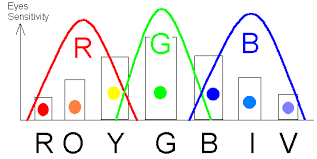
Primary colors come in two types as shown in the image below. Mixing light has an additive effect (shown on the left) while mixing pigments has a subtractive effect (shown on the right).

Because TVs mix light, this effect is additive (i.e. red and green make yellow, red and blue make magenta, and blue and green make cyan). To make white we mix all three primary colors (red, green, and blue) at their full intensity. Mixing them evenly at lower intensity levels produces gray while black is merely no light at all. White from the TV has a fundamentally different quality compared with white from the sun. White from the sun contains all frequencies while white from the TV only has red, green, and blue, but these whites still look the same to our eyes.
Mixing pigments takes away light. Each pigment absorbs different frequencies so mixing them together combines these effects. Magenta pigment absorbs green light and yellow absorbs blue light. When these pigments are mixed, all but the red light are absorbed. Magenta, yellow, and cyan are the three primary pigment colors used by modern printers. There are many possible primary color schemes for pigment, but the magenta-yellow-cyan scheme works better than the red-yellow-blue scheme most of us learned in grade-school art class. Artists know very well that you cannot mix every possible color with only red, yellow, blue, black, and white paint. This is why oil paints come in so many different colors.
Once again, the reason mixing colors works, whether light or pigment, is because of the way our eyes work. Our intelligent alien visitors may have eyes that work differently. They might have a wider or narrower range of frequencies they can see. They might see infrared or ultraviolet, or they might not even see the red or violet that we see. They might only distinguish intensity, or they may have greater or lesser color acuity because they have more or fewer light sensitive cells analogous to our cones. For example, if they had four cones, they might need a primary color scheme of four colors to display all the colors they can perceive. There is no guarantee that they will look at our TVs and at the corresponding natural scene and perceive them as the same scene.
Besides color, there are other considerations as well. We view TV at 30 frames per second and movies at 24 frames per second. This works with the frame rate and persistence of vision characteristic of our brains to create the illusion of smooth motions. Our alien visitors' brains may have a faster frame rate and they might see the flicker in our devices, which could be so distracting to them that they do not see or enjoy the action the way we do. All this would also be true of our visitors' technological devices. Their devices would be tuned to their brains and we might not perceive the output of their devices at all they way the aliens perceive it.
So whose version of reality would be more correct? Both and neither. Both we and our alien visitors evolved perception mechanisms suitable to our respective worlds which enabled us to survive and develop a technological society. In a practical sense, perception is reality, just as in politics. At the same time, it is not possible for either of our perception mechanisms to completely represent the real world. That would be too much information to process. Instead, evolution gives us just enough to survive better than the alternative while working within practical limits.
Comparing ourselves with a hypothetical alien species is an exercise in imagining whether things are as they must be, or only as they happen to be in our particular case. This is just another way of moving us further from the position we once occupied at the center of the universe before Copernicus and Galileo removed us from that spot more than 400 years ago.
Our TVs only produce three different colors: red, green, and blue. With these three colors, our TVs are able to reproduce the sensation of any color we are capable of sensing. This little economical trick is made possible not because of the inherent properties of light, but because of the inherent properties of our eyes. In other words primary colors have nothing to do with the physics of light, but everything to do the eyes and the brain.
Our eyes have four different types of light-sensitive cells. One type of cell, commonly called a rod, is very sensitive to visible light but can only distinguish varying levels of intensity. Three other types, the cones, require higher levels of light, but they allow us to distinguish different colors because each type of cone is sensitive to a different range of frequencies. One type of cone is most sensitive around the red range, another is sensitive near green, and a third near blue. There is overlap. Both the red cones and the green cones are stimulated by spectral yellow. This allows our devices to fool our eyes and minds into seeing yellow by mixing red light and green light. From a physics standpoint, red and green mixed is not the same as yellow, but we cannot distinguish these two cases. The graph below shows the approximate range of sensitivity for each of the three types of cone cells.
Primary colors come in two types as shown in the image below. Mixing light has an additive effect (shown on the left) while mixing pigments has a subtractive effect (shown on the right).
Because TVs mix light, this effect is additive (i.e. red and green make yellow, red and blue make magenta, and blue and green make cyan). To make white we mix all three primary colors (red, green, and blue) at their full intensity. Mixing them evenly at lower intensity levels produces gray while black is merely no light at all. White from the TV has a fundamentally different quality compared with white from the sun. White from the sun contains all frequencies while white from the TV only has red, green, and blue, but these whites still look the same to our eyes.
Mixing pigments takes away light. Each pigment absorbs different frequencies so mixing them together combines these effects. Magenta pigment absorbs green light and yellow absorbs blue light. When these pigments are mixed, all but the red light are absorbed. Magenta, yellow, and cyan are the three primary pigment colors used by modern printers. There are many possible primary color schemes for pigment, but the magenta-yellow-cyan scheme works better than the red-yellow-blue scheme most of us learned in grade-school art class. Artists know very well that you cannot mix every possible color with only red, yellow, blue, black, and white paint. This is why oil paints come in so many different colors.
Once again, the reason mixing colors works, whether light or pigment, is because of the way our eyes work. Our intelligent alien visitors may have eyes that work differently. They might have a wider or narrower range of frequencies they can see. They might see infrared or ultraviolet, or they might not even see the red or violet that we see. They might only distinguish intensity, or they may have greater or lesser color acuity because they have more or fewer light sensitive cells analogous to our cones. For example, if they had four cones, they might need a primary color scheme of four colors to display all the colors they can perceive. There is no guarantee that they will look at our TVs and at the corresponding natural scene and perceive them as the same scene.
Besides color, there are other considerations as well. We view TV at 30 frames per second and movies at 24 frames per second. This works with the frame rate and persistence of vision characteristic of our brains to create the illusion of smooth motions. Our alien visitors' brains may have a faster frame rate and they might see the flicker in our devices, which could be so distracting to them that they do not see or enjoy the action the way we do. All this would also be true of our visitors' technological devices. Their devices would be tuned to their brains and we might not perceive the output of their devices at all they way the aliens perceive it.
So whose version of reality would be more correct? Both and neither. Both we and our alien visitors evolved perception mechanisms suitable to our respective worlds which enabled us to survive and develop a technological society. In a practical sense, perception is reality, just as in politics. At the same time, it is not possible for either of our perception mechanisms to completely represent the real world. That would be too much information to process. Instead, evolution gives us just enough to survive better than the alternative while working within practical limits.
Comparing ourselves with a hypothetical alien species is an exercise in imagining whether things are as they must be, or only as they happen to be in our particular case. This is just another way of moving us further from the position we once occupied at the center of the universe before Copernicus and Galileo removed us from that spot more than 400 years ago.
Thursday, September 27, 2012
Why Don't We Just Run Cars on Hydrogen?
Sometimes when I talk to my kids about energy-related issues, they may propose a solution that seems quite simple and obvious to them. The problem is that the real issues may be more complex than they appear on the surface and may require some foundational knowledge to fully understand. One such potential solution to our energy needs is hydrogen-powered cars. Hydrogen is a clean burning fuel and is certainly plentiful given all the hydrogen that exists in Earth's oceans. Why do we not just use hydrogen to solve our energy problems?
To understand why we do not use hydrogen more as a fuel, we need some basic chemistry knowledge. Burning is a chemical reaction where energy is released. When hydrogen is burned, oxygen atoms from the atmosphere each combine with two hydrogen atoms to form water as a waste product while giving off heat in the process. Other chemical reactions consume energy rather than release energy. The problem with hydrogen is that it is very light and very reactive. All of the hydrogen on earth has either floated away into space because it is so light, or it has bonded with other atoms and requires at least as much energy to release as what we get from burning it.
Hydrogen then can be a convenient way to store energy, like a battery, but it is not a source of energy. Extracting hydrogen from water takes as much energy as we recover from burning it. It is like using boulders rolling down a hill as a source of energy. The problem is they are all currently lying at the bottom of the hill. We could push them to the top of the hill and then use them, but then we might as well just use the energy directly that we used to push them up the hill.
The only reason we might prefer the rolling boulders is that they give us a lot of energy fast while the process of pushing them up is longer and slower even though the total energy is equivalent (minus whatever is lost through inefficiency). This is why hydrogen is sometimes used as rocket fuel. The real source of energy was the coal that generated the electricity that was used to extract the hydrogen from water. But the hydrogen works much better as rocket fuel because it can release its energy much faster.
Backing up even further, the energy in the coal ultimately came from the sun. Prehistoric plants used photosynthesis to convert sunlight into chemical energy that was eventually buried, becoming the fossil fuels we use as our primary energy source today. The energy from the sun comes from hydrogen, so in essence we are already running everything on hydrogen. The difference is that the process that generates energy in the sun is nuclear rather then chemical. Chemical processes only rearrange atoms. Nuclear reactions change one kind of atom into another either by combining nuclei (fusion) or splitting nuclei (fission). For elements lighter than iron, fusion releases energy, while elements heavier than iron release energy with fission. The amounts of energy are several orders of magnitude greater than those involved with chemical reactions.
Unlike regular burning of hydrogen, nuclear fusion could provide us with all the energy we would ever need. The problem is that extremely high temperatures and close proximity are required to start and sustain a reaction. Stars do this with gravity, but it is not so easy on earth. So far the only way we have been able to use the energy of nuclear fusion is in thermonuclear (hydrogen) bombs. These blow themselves apart by design. To sustain the reaction and produce usable energy we would have to hold it together. This is a challenge we have yet to resolve.
To understand why we do not use hydrogen more as a fuel, we need some basic chemistry knowledge. Burning is a chemical reaction where energy is released. When hydrogen is burned, oxygen atoms from the atmosphere each combine with two hydrogen atoms to form water as a waste product while giving off heat in the process. Other chemical reactions consume energy rather than release energy. The problem with hydrogen is that it is very light and very reactive. All of the hydrogen on earth has either floated away into space because it is so light, or it has bonded with other atoms and requires at least as much energy to release as what we get from burning it.
Hydrogen then can be a convenient way to store energy, like a battery, but it is not a source of energy. Extracting hydrogen from water takes as much energy as we recover from burning it. It is like using boulders rolling down a hill as a source of energy. The problem is they are all currently lying at the bottom of the hill. We could push them to the top of the hill and then use them, but then we might as well just use the energy directly that we used to push them up the hill.
The only reason we might prefer the rolling boulders is that they give us a lot of energy fast while the process of pushing them up is longer and slower even though the total energy is equivalent (minus whatever is lost through inefficiency). This is why hydrogen is sometimes used as rocket fuel. The real source of energy was the coal that generated the electricity that was used to extract the hydrogen from water. But the hydrogen works much better as rocket fuel because it can release its energy much faster.
Backing up even further, the energy in the coal ultimately came from the sun. Prehistoric plants used photosynthesis to convert sunlight into chemical energy that was eventually buried, becoming the fossil fuels we use as our primary energy source today. The energy from the sun comes from hydrogen, so in essence we are already running everything on hydrogen. The difference is that the process that generates energy in the sun is nuclear rather then chemical. Chemical processes only rearrange atoms. Nuclear reactions change one kind of atom into another either by combining nuclei (fusion) or splitting nuclei (fission). For elements lighter than iron, fusion releases energy, while elements heavier than iron release energy with fission. The amounts of energy are several orders of magnitude greater than those involved with chemical reactions.
Unlike regular burning of hydrogen, nuclear fusion could provide us with all the energy we would ever need. The problem is that extremely high temperatures and close proximity are required to start and sustain a reaction. Stars do this with gravity, but it is not so easy on earth. So far the only way we have been able to use the energy of nuclear fusion is in thermonuclear (hydrogen) bombs. These blow themselves apart by design. To sustain the reaction and produce usable energy we would have to hold it together. This is a challenge we have yet to resolve.
Thursday, September 20, 2012
Orbital Dynamics
As a follow up to some of my previous posts about space flight, I have decided to discuss orbital dynamics. The general public is grossly misinformed about real space flight thanks to so much misinformation in movies and on TV. The Jet Propulsion Laboratory has an excellent tutorial here for those who want to get into even more detail about space flight.
Why discuss orbital dynamics? Because every body in the universe is in orbit around something. Furthermore, orbital dynamics are interesting because they are so non-intuitive when it comes to maneuvering a space ship. Understanding orbital dynamics is essential to real space flight.
Johannes Kepler discovered by observation that planets follow elliptical orbits around the sun. Isaac Newton showed that elliptical orbits are a consequence of the inverse square law of gravity. More generally, orbits are conic sections. When you throw a baseball, its path is a parabola. A comet that only approaches the sun once, and then heads for interstellar space is following a hyperbolic curve.
If two space craft are orbiting the earth in the same orbit, but separated by some distance, how can they rendezvous or send items back and forth. MIT Professor Walter Lewin discusses this problem in his ham sandwich lecture, which is posted online here. As Lewin states it, how do you throw a ham sandwich to the hungry astronaut in the space ship that is in orbit ahead of you? You might want to just throw it toward him, but that would put the ham sandwich into a higher orbit, thus ultimately slowing it down and sending it further away from the hungry astronaut. The right way to send him the ham sandwich is to throw it backwards, away from his space ship. This would initially slow down the ham sandwich, but then it would pick up speed as it fell into a lower orbit. If done just right, the elliptical orbit of the ham sandwich would intersect the more circular orbit of the hungry astronaut's space ship at just the right time on the next orbit.
The astronauts in the Gemini program in the 60s, the first to execute a rendezvous in earth orbit, had to learn to go contrary to their intuition. The first required maneuver was to match the plane of the target. Next, it was necessary for the perusing ship to be in a lower orbit so it could gain on the target. Once the target was in sight, the astronauts had to fight their natural tendency to fire thrusters to move their space ship toward the target. Instead, they needed to maintain their lower orbit, only pulling up into the same orbit as the target at exactly the right moment. Of course, this is all old hat now for real astronauts, but the complex and intricate details are not always fully appreciated by a general public fed with a steady diet of Star Trek and Star Wars.
Orbital dynamics also come into play in planning trajectories for interplanetary travel, but that is a subject for another post. If you can't wait until then, check out the JPL Space Flight Tutorial I mentioned previously.
Why discuss orbital dynamics? Because every body in the universe is in orbit around something. Furthermore, orbital dynamics are interesting because they are so non-intuitive when it comes to maneuvering a space ship. Understanding orbital dynamics is essential to real space flight.
Johannes Kepler discovered by observation that planets follow elliptical orbits around the sun. Isaac Newton showed that elliptical orbits are a consequence of the inverse square law of gravity. More generally, orbits are conic sections. When you throw a baseball, its path is a parabola. A comet that only approaches the sun once, and then heads for interstellar space is following a hyperbolic curve.
If two space craft are orbiting the earth in the same orbit, but separated by some distance, how can they rendezvous or send items back and forth. MIT Professor Walter Lewin discusses this problem in his ham sandwich lecture, which is posted online here. As Lewin states it, how do you throw a ham sandwich to the hungry astronaut in the space ship that is in orbit ahead of you? You might want to just throw it toward him, but that would put the ham sandwich into a higher orbit, thus ultimately slowing it down and sending it further away from the hungry astronaut. The right way to send him the ham sandwich is to throw it backwards, away from his space ship. This would initially slow down the ham sandwich, but then it would pick up speed as it fell into a lower orbit. If done just right, the elliptical orbit of the ham sandwich would intersect the more circular orbit of the hungry astronaut's space ship at just the right time on the next orbit.
The astronauts in the Gemini program in the 60s, the first to execute a rendezvous in earth orbit, had to learn to go contrary to their intuition. The first required maneuver was to match the plane of the target. Next, it was necessary for the perusing ship to be in a lower orbit so it could gain on the target. Once the target was in sight, the astronauts had to fight their natural tendency to fire thrusters to move their space ship toward the target. Instead, they needed to maintain their lower orbit, only pulling up into the same orbit as the target at exactly the right moment. Of course, this is all old hat now for real astronauts, but the complex and intricate details are not always fully appreciated by a general public fed with a steady diet of Star Trek and Star Wars.
Orbital dynamics also come into play in planning trajectories for interplanetary travel, but that is a subject for another post. If you can't wait until then, check out the JPL Space Flight Tutorial I mentioned previously.
Subscribe to:
Posts (Atom)